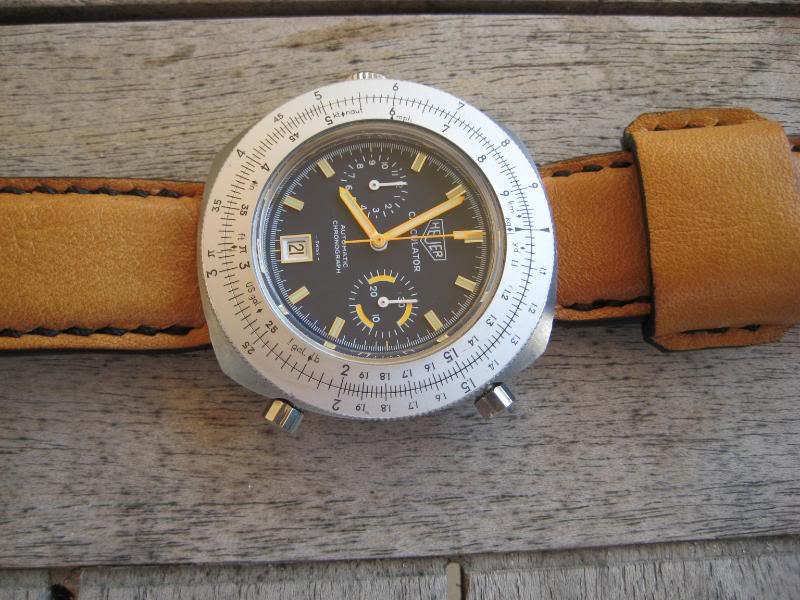
As a follow-up to a recent post that I made regarding a vintage Seiko "Slide Rule", I wanted to look into this type of watch a little further. I wanted to know how they work and what all of the different components work. I my research, I ran across a very cool site with historical content on this type of watch, explanations of the slide rule function as well as vintage/contemporary examples of slide rule watches. I have pasted an excerpt below and provided a link for those who are interested.
FYI- there are several links at the bottom of the lead page that contain great information!
Link to original content:
http://sliderulewatches.googlepages.com/history.html This is an excerpt from an article that Art Simon posted:
Slide Rule Wristwatches
Corrections, comments and additions to
Art Simon What is a slide rule watch?The Slide Rule Wristwatch has been described as the pinnacle of pre-ic high tech. It's the ultimate analog gadget--not only does it tell the time, it's also a calculator. You might use a slide rule watch to do currency converstions while traveling, calculate the cost of meal with tip at a restaurant, or if you are a pilot planning a flight plan, even more technical calculations like fuel burn, wind correction, and time en route.
A slide rule wristwatch has two logarithmic scales. Usually, one scale is on a movable bezel, and a second is fixed or printed on the face of the watch. Calcuations are made by rotating the bezel to fix the relative position the two scales.

The two scales form proportions that are useful in math problems involving multiplcation and division. For example, here's how I might calculate the cost of a meal in a restaurant after including the tip. For a 20% tip, I could line up 12 on the outer ring above 10 on the inner ring. Now all the numbers on the outer ring are 20% higher than the numbers on the inner ring. If my check was $15, the total cost of the meal with tip will be the number on the outer scale above 15, which is $18. If the check was for $150, I could find that the cost with tip was $180, just by ignoring the zeros.
Let's say I was traveling in Europe and wanted to convert euros to dollars. Since 1 euro will buy around 1.4 dollars (ouch!) I could line up 14 on the outer scale with 10 on the inner dial. Now all the numbers are in proportion with the outer scale representing dollars and the inner dial representing euros. To find out how little $10 is worth, I could look at the number on the inner scale under 10. To find what 5 euros is worth, I'd look at the number on the outer scale that is above 5. (For more instructions on the use of a slide rule watch see
Casio's Watch with slide rule FAQ)
The slide rule is sometimes confused with a
tachymeter, a single scale on some wristwatches that is used with the second hand to calculate speed.
The origins of the Slide Rule WristwatchThe first slide rule watch was probably this pocket watch designed by Meyrat & Perdrizet in France near the turn of the century.
Rechnerlexikon, a German website on mechanical computing describes it in an article on the history of slide rules as "a French pocket watch, with a slide rule around the clock dial, was probably the first real watch with a slide rule." It gives the date of the watch as 1890. Much of the early history of slide rule pocket watches is obscure, and it's not helped by the fact that the term "Pocket Watch Slide Rule" is often used for a slide rule in a pocket watch case that has no time keeping ability. (Photo from Edwin Datschefski's slide rule watch site)

The slide rule wristwatch has a relatively recent origin, arriving in 1940 during the beginnings of World War 2. The beginning of war brought an influx of orders to the Swiss watch manufacturers from all over the world, and with it came the introduction of new watch models with new features. There is some dispute about who manufactured the first slide rule wristwatch, but it was certainly a Swiss firm. The first three slide rule wristwatches came from Breitling, Juvenia and MIMO (Manufacture Internationale de Montres Or). It appears that the extremely rare Mimo-Loga may have been first, with its
patent application appearing on July 27, 1940, just weeks before
Breitling's patent for the Chronomat was submitted on August 26, 1940. The Juvenia Arithmo doesn't seem to have become commercially available until later, around 1945. (The French page
Le Breitling Chronomat et les premières montres avec règle à calcul does an excellent job researching the patents for the early slide rule watches.) (Mimo-Loga scan from Peter from Germany & Juvenia Arithmo photo from Edwin Datschefski's slide rule watch site)

These first three slide rule wristwatches each used a different set of scales for the slide rule. The only reason I can see for this is that there were concerns of violating each other's patents. The Mimo-Loga used the C and D single-decade logarithmic scales from the standard slide rule. These scales are are useful for multiplication and division, and the numbers on both scales increase from left to right. By contrast, the early Breitling Chronomats used the C and CI "inverted" scales, which are useful for calculations involving reciprocals but can be used for multiplication and division as well. These inverted scales can be seen in Breitling's 1940 Swiss government
patent application for a circular slide rule mounted on a wristwatch. The submitted drawing shows a slide rule with an an inner scale running left to right, but the numbers on the outer scale running right to left. The Juvenia Arithmo used a third arrangement with three logarithmic scales: C, D and CI. The Arithmo's C and D scales are layed out in reverse running right to left. The innermost scale is the CI "inverted" logarithmic scale, running left to right. The Arithmo also has a magnifying glass ring on outside of the bezel ring to aid in reading the scales
In 1952, Breitling introduced a new slide rule wristwatch with a significant innovation. The first three slide rule wristwatchs were designed with scientitists, engineers, and mathematicians in mind. However Breitling's new model, called the Navitimer, was intended for pilots. This model has defined what is known as the
flight computer watch. The Navitimer has the same two C and D log scales as the Mimo-Loga, running left to right, but probably avoided infringing on the Mimo-Loga patent by adding a third scale from the pilots circular slide rule (also known as the E6B "whiz wheel") for time and distance calculations. In addition, the Navitimer was marked for kilometers, statute miles and nautical miles at locations that allow quick conversions from one unit to another. Later flight computer watches have added markings for additional unit conversions (e.g. gallons, liters, pounds, kilograms, etc.) but are otherwise functionally identical to the first Navitimer. The name was a combination of the words Navigation & Timer, since the watch allowed pilots to make calculations useful to navigation as well as to tell the time. It was adopted by the AOPA (Aircraft Owners & Pilots Association) as their official watch, and the early Breitling Navitimers have the AOPA wing logo prominantly displayed on the dial.
 Modern Slide Rule Watches
Except for a Mimo-Loga variation that was briefly released by Girard-Perregaux, a brand which was owned by parent company MIMO, no other watch manufacturers introduced any slide rule models until the 60s. Swiss patents have a term of 20 years, and so it's probably no coincidence that after the Mimo-Loga patent would have expired other slide rule watches began to appear using its layout. In fact, the scale layout used by the Mimo-Loga has since become the standard for virtually all slide rule watches. With the exception of some models in the
Breitling for Bentley line, all current slide rule watches use the same scale layout as the Mimo-Loga, with the two C and D scales running left to right. The other scales from the standard slide rule which are used for roots, trigonometry, logarithms or other mathematical operations are not used on wristwatches. (Slide rules are generally not useful for addition or subtraction.)
These new slide rule models of the 60s and early 70s came first from Swiss brands like Gallet, Selectron, Agon, Ollech & Wajs, Eberjax, Cimier and later from Sinn, Mondia, Heuer, Fortis and many others. The Japanese introduced models as well with Seiko introducing it's first slide rule watch in 1969 and Citizen producing a model in the early 70s. By the nineties, even the mass market budget brand Casio had introduced slide rule models, and now many inexpensive Chinese watches with slide rules have also become available.

Modern slide rule watches can be broadly categorized between those that use only two scales, like the Mimo-Loga and flight computers that incorporate a third time-distance scale like the Breitling Navitimer. A very small number of slide rule watches (like the Camy Rally King and Citizen RecordMaster Rally Custom) have only one logarithmic scale that rotates around a fixed time scale. This layout would be useful only for making time-distance calculations (presumably of interest to rally divers) and not generalized multiplication and division problems. There are also watches that have only one logarithmic scale presumably for decoration since a single scale wouldn't be of any use in making calculations.
While there are only a few variations of the slide rule used on watches, there are many variations of the watch. They can have an analog, digital or combination display, and have a mechanical, self-winding or battery-operated quartz movement. Most incorporate a stopwatch (called a chronograph movement), and can also include a day, date or moonphase display.



 Subject: What exactly is a slide rule watch?
  Fri Feb 12, 2010 7:57 pm